Toward Million-Unit 3D Printing of Smartphone Housings
In the consumer electronics industry that pursues the ultimate precision, when titanium alloy mid-frames, aluminum alloy structural components, and precision functional parts collectively advance toward million-unit production scale, the traditional "prototype-trial-and-correction" additive manufacturing model has hit its ceiling. The true challenge lies not merely in fabricating precise metal components, but in proving to top-tier brands like Apple that every single piece, every batch, and every generation of products satisfies the complete qualification closed loop from Design Qualification (DQ), Installation Qualification (IQ), Operational Qualification (OQ) to Performance Qualification (PQ). This is precisely the core logic behind SynaCore AM-DT Digital Twin Platform in building the next generation of manufacturing intelligence.
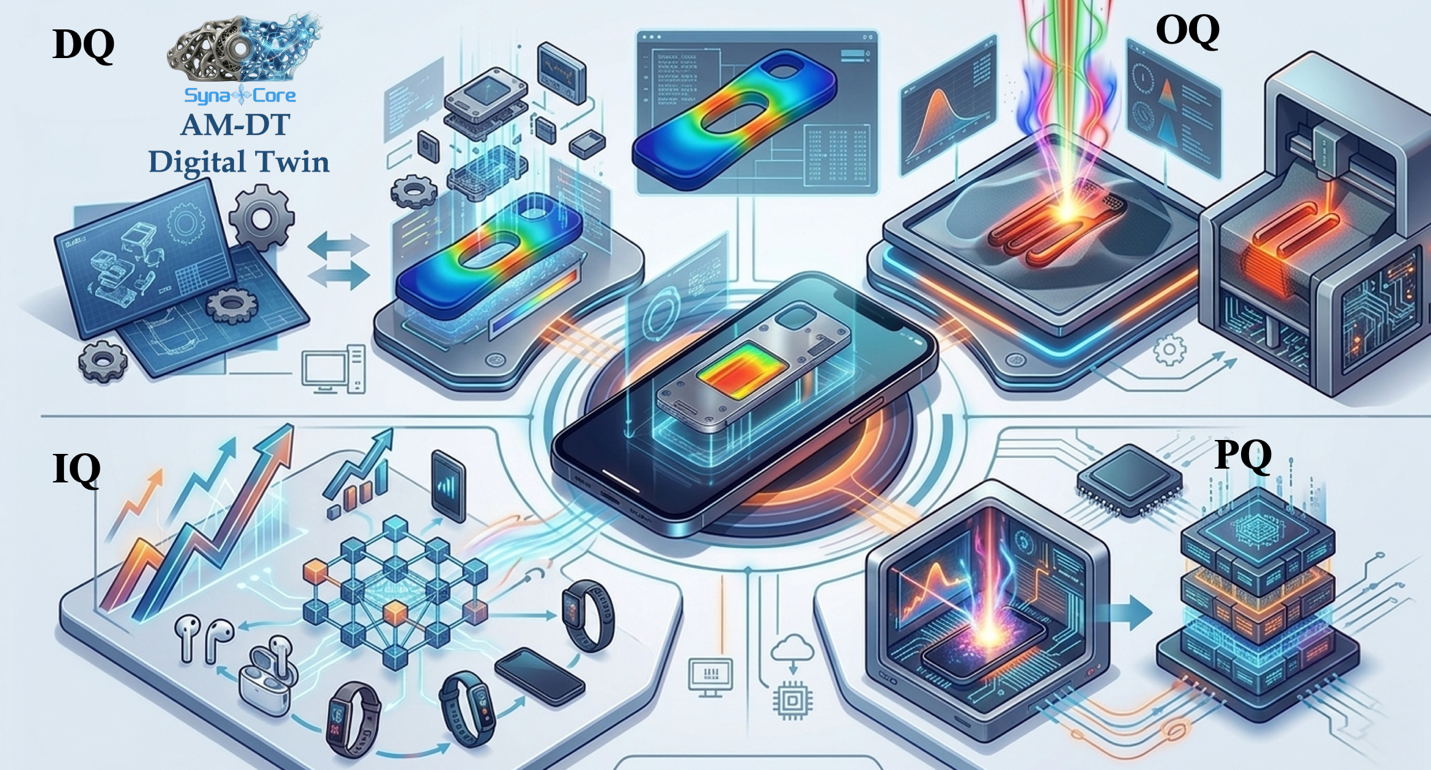
DQ Design Qualification: Securing "Right First Time" Physical Design in the Virtual World
Concerns of Consumer Electronic Manufacturers: How to balance design innovation with manufacturability? How can we prevent late-stage process constraints from triggering design iterations that delay new product time-to-market? Taking the exacting standards of a brand like Apple as an example—"Design is Quality"—prior to design freeze, proving that the selected technical pathway (material + process + equipment combination) can meet Apple's stringent requirement of "99.98% repeatability," thereby avoiding costly engineering changes downstream. Establishing a complete traceability matrix from design inputs to verification testing, ensuring every design decision is supported by subsequent validation data.
In traditional additive manufacturing workflows, a validation gap exists between design and manufacturing departments. A stunning topology-optimized structure or an ultra-thin, lightweight mid-frame design often proves unprintable only after pilot production begins, resulting in weeks or even months of design rework.
The SynaCore Solution: SynaCore AM-DT Digital Twin represents not merely a replacement for traditional simulation, but the construction of a multi-scale, multi-fidelity data-physics coupling framework. At the microscopic level, it tracks grain nucleation and growth, and their influence to mechanical properties; at the mesoscopic level, it resolves melt pool fluid dynamics; at the macroscopic level, it governs thermal-structural coupled evolution—achieving full-chain connectivity across material, process, and performance.
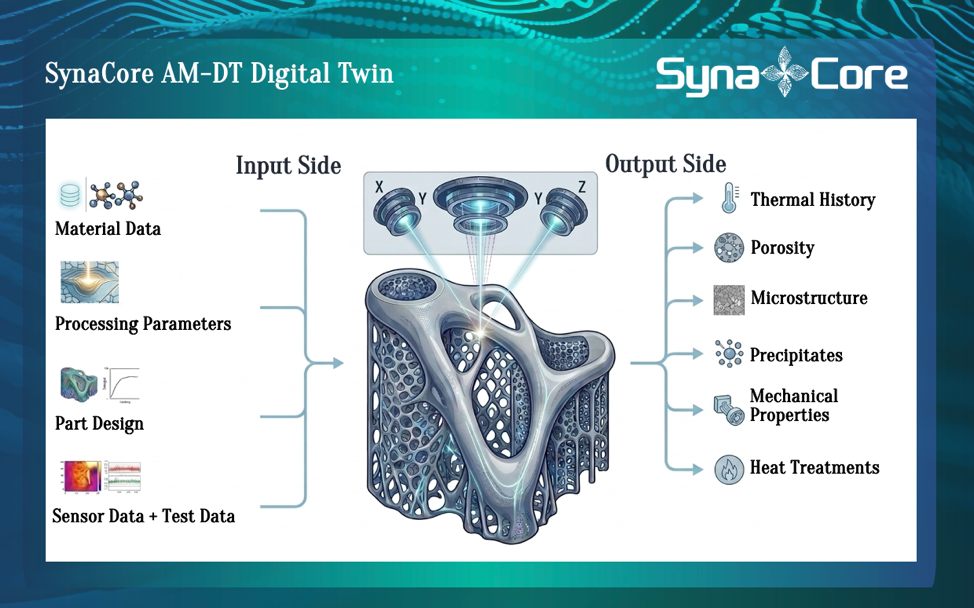
At the DQ stage, SynaCore AM-DT Digital Twin front-loads manufacturing physics into the design phase. For instance, designers can receive immediate feedback during CAD: will this titanium alloy clip's overhang structure exhibit sagging risk during laser melting? Through high-fidelity simulation, material behavior under specific process conditions is accurately predicted, elevating manufacturability analysis from "empirical judgment" to "physics-based computation."
Traditional additive manufacturing R&D follows a "design-manufacture-test-correct" loop, with each iteration cycle measured in weeks or even months. Once SynaCore AM-DT Digital Twin is deployed, enterprises can enter "virtual commissioning" mode, completing thousands of parameter sweeps through the twin prior to physical manufacturing, directly outputting optimal process windows, including ready-to-print adaptive toolpaths—compressing R&D cycles from months to days.
SynaCore AM-DT Digital Twin operates its thermal solver, grain growth model, solidification analysis module, and melt pool fluid dynamics solver in parallel and scales well with CPU cores. Creating value for users starting from the DQ stage: converging design iterations within the digital realm.
IQ Installation Qualification: Achieving Digital Cloning of "Manufacturing Capability" Rather Than "Equipment Parameters"
Concerns of Consumer Electronic Manufacturers: How to ensure that equipment across different global production sites and different batches can stably output quality-consistent parts? How to rapidly replicate and validate capacity of new production lines? At this stage, brands focus on "baseline is trust"—through documented evidence proving that manufacturing equipment has been correctly and stably installed in a controlled environment per manufacturer specifications, eliminating subsequent quality drift risks arising from installation deviations. Ensuring all calibration, maintenance, and operation documentation is complete, establishing reliable physical and metrological baselines for OQ.
Traditionally, Installation Qualification (IQ) has focused on hardware parameters. However, even for identical equipment models, minute variations in laser status, gas flow fields, and powder spreading precision become amplified in final parts. This makes global capacity deployment a time-consuming, uncertainty-ridden arduous task.
The SynaCore Solution: The core qualitative transformation of Digital Twin lies in bidirectional data closed-loop. Physical entity operating conditions feed back to the digital twin, while the twin's models more accurately simulate physical processes, forming an end-to-end "sense-cognize-decide" closed loop.
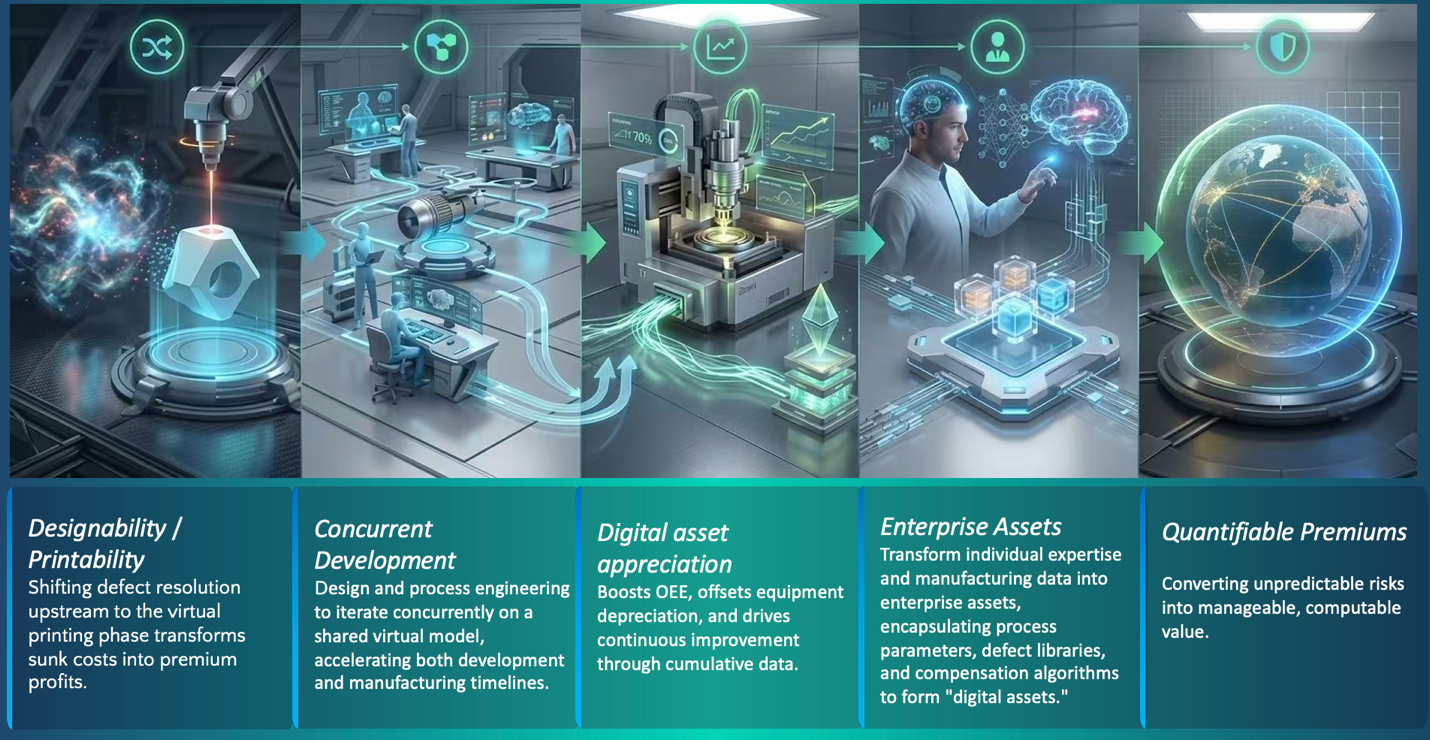
By feeding sensor and quality inspection data back to the Digital Twin, every print run injects unique process fingerprints into SynaCore AM-DT: the phase transformation laws of specific alloys under specific thermal histories, the influence patterns of complex path planning on residual stress, and the mapping relationships between environmental disturbances and defect evolution. These exclusive process insights precipitate into a unique and irreplicable data intelligence moat for each manufacturer. The more extensively a manufacturer's Digital Twin is trained, the more difficult their process database becomes to replicate. As manufacturing batches accumulate, the Digital Twin's prediction accuracy improves exponentially, and control over the process window becomes increasingly precise. This means that even if competitors possess identical equipment, they cannot replicate equivalent levels of process stability and yield rates in a short timeframe. This becomes the most formidable competitive barrier, as well as an asset that appreciates in value for the manufacturer alongside production volume.
Moreover, for heat treatment—a post-processing step typically required in additive manufacturing—the SynaCore AM-DT platform transforms the "black box" of heat treatment into a predictable pathway of microstructural evolution through the three-level coupling of macroscopic thermal fields, mesoscopic diffusion, and microscopic phase transformation.
For the additively manufactured maraging steel shown in the bellowing figure, variations in precipitate morphology, size, and distribution at different temperatures can be pre-predicted within the SynaCore AM-DT digital twin software, thereby enabling:
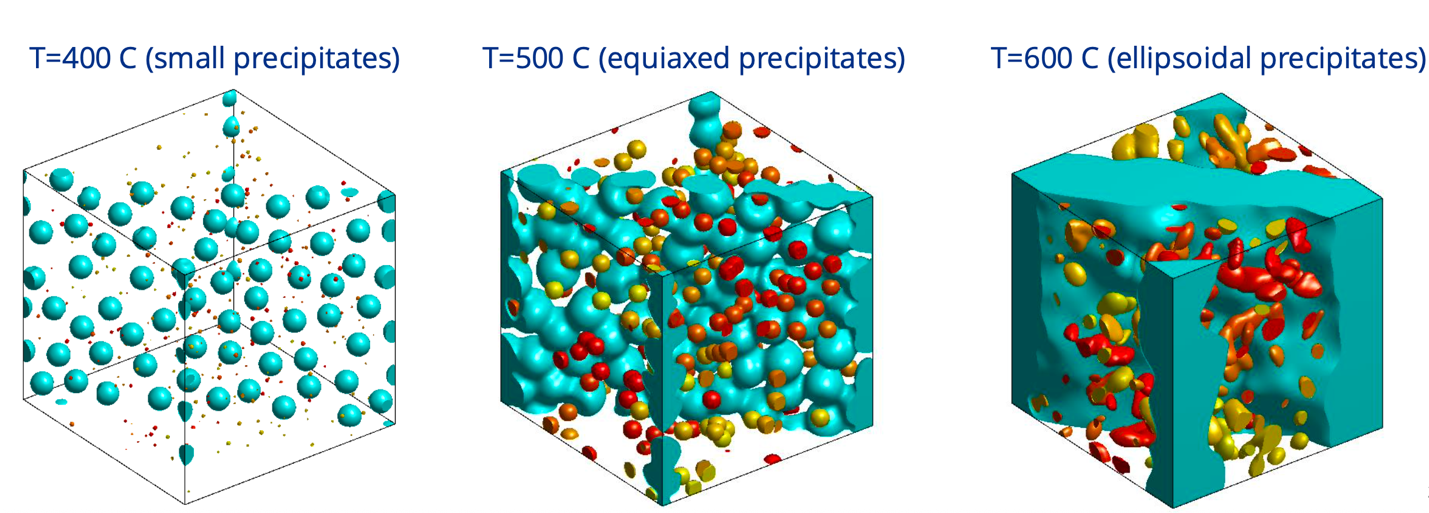
• Avoidance of over-ageing softening at 600°C
• Locking in the optimal equiaxed precipitate zone near 500°C
• Provision of a process safety margin for nanoscale strengthening during low-temperature ageing at 400°C.
This achieves full-process digital twin coverage for additive manufacturing, extending from "print prediction and optimization" to "heat treatment performance customization."
OQ Operational Qualification: Virtually Hunting the "Uncertainty" Before Mass Production
Concerns of Consumer Electronic Manufacturers: How do minute fluctuations in process parameters affect long-term yield rates at million-unit scales? How can mass, difficult-to-detect internal quality defects be avoided? How can human variables be eliminated?
The objective of the OQ stage is to confirm that under predefined process windows, the production process can stably output qualified products. However, for materials such as titanium and aluminum alloys, process windows are extremely narrow. Traditional Statistical Process Control (SPC) methods relying on large numbers of trial samples struggle to exhaust all potential risks—particularly those arising at micro-scales or under complex thermo-mechanical coupling.
The SynaCore Solution: Traditional 3D printing relies on fixed recipes—predetermined laser power, scan speed, and hatch spacing—these parameters ignore the constantly evolving thermal field during the printing process. SynaCore AM-DT Digital Twin integrates Adaptive ToolPath, generating optimized scan paths ready for production based on transient thermal finite element analysis. By fully predicting thermal responses in digital space prior to actual printing, SynaCore enables users to print high-quality parts with stable thermal signatures. Based on SynaCore's proprietary optimization algorithms, SynaCore's Adaptive ToolPath simultaneously considers inter-layer temperature evolution (e.g., heat accumulation in tall, thin-walled parts) as well as intra-layer temperature variations, which is particularly critical for complex geometries such as overhangs,bridges, and thin supports
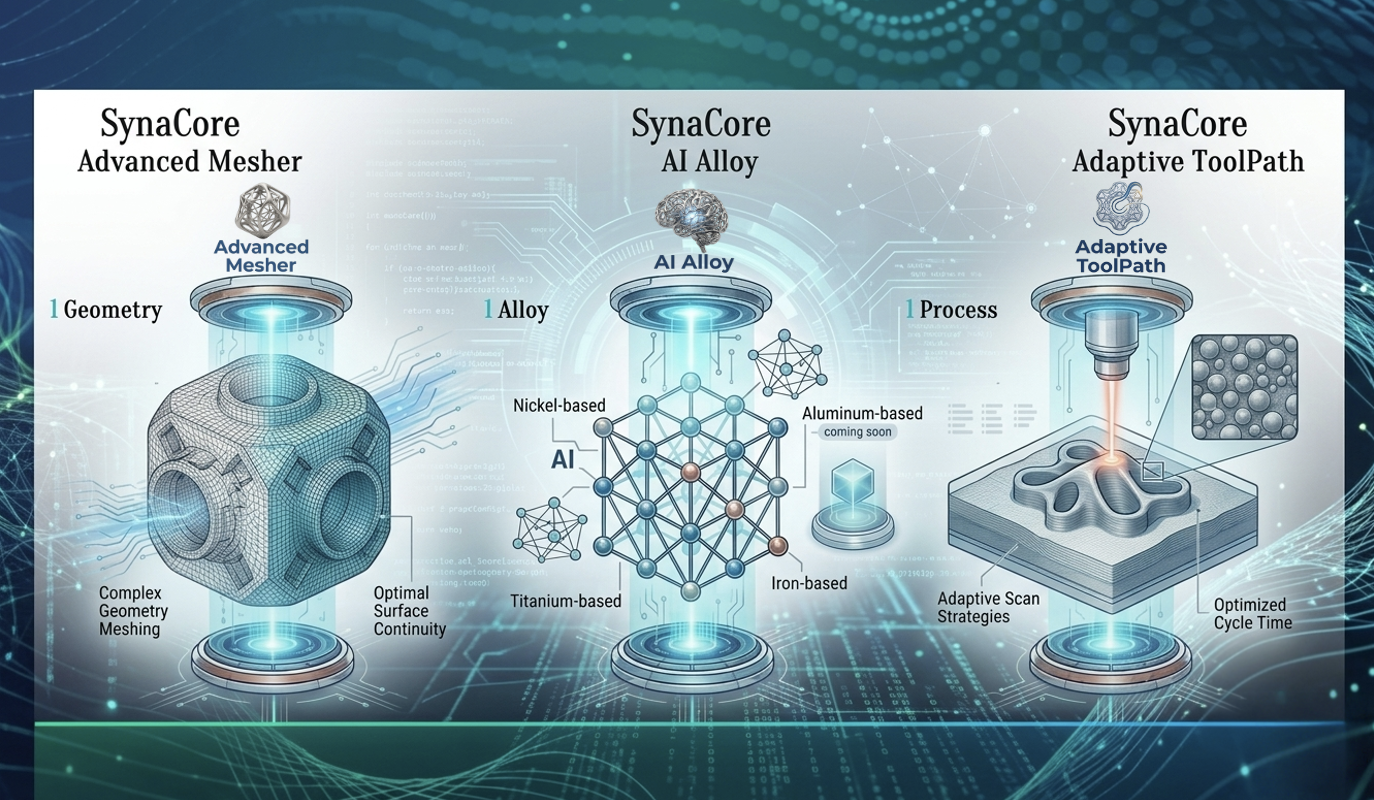
Further, the system continuously absorbs feedback data—including deformation induced by residual stress, solidification crack susceptibility index, and lack-of-fusion porosity distribution—to optimize the SynaCore AM-DT Digital Twin. Every subsequent print benefits from accumulated process knowledge, enabling the continuous evolution of the SynaCore Digital Twin.
PQ Performance Qualification: From "Testing Samples" to Issuing Digital Twin Enhanced Digital Passports for "Every Single Part"
Concerns of Consumer Electronic Manufacturers: How can we prove that every part's performance meets stringent standards at lower cost and with greater speed? How can we achieve full lifecycle traceability from raw material to finished product? How can we ensure that parts maintain performance throughout their lifecycle during drop tests, bending fatigue tests, and thermal cycling tests (simulating actual usage environments)?
Traditional PQ relies heavily on destructive sampling (tensile testing, fatigue testing, metallographic analysis). This approach is costly, time-consuming, and sampling cannot represent the entire population, let alone trace the "life journey" of each individual part.
The SynaCore Solution: In the near future, SynaCore will usher in a new paradigm of "Digital Pre-Qualification." Before a part is physically realized, its Digital Twin has already computed a prediction report of its microstructure and final mechanical properties based on validated process parameters. This report itself can serve as a powerful pre-qualification document submitted to the brand. More importantly, every successfully produced part can receive a Digital Twin-enhanced Digital Passport, permanently sealing its unique "genetic" information.
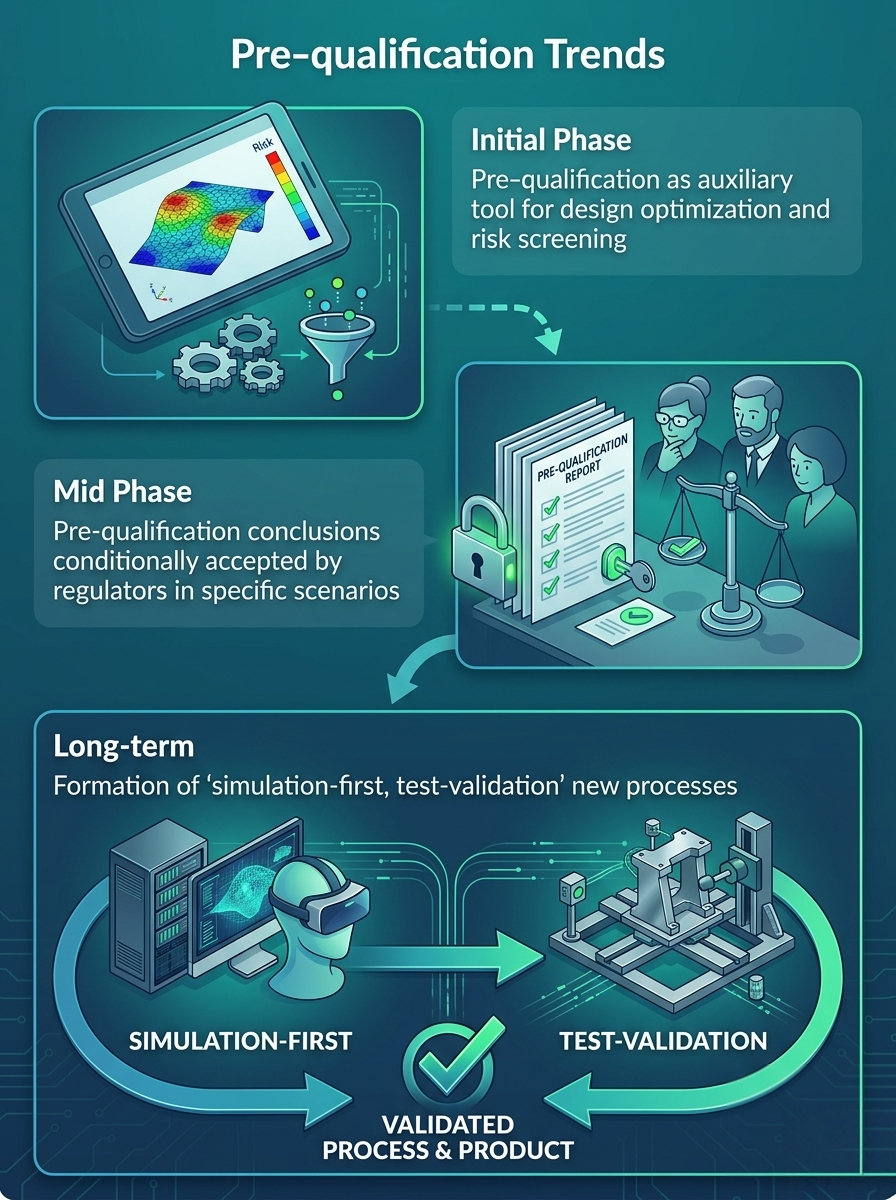
Value Created for Customers: Achieving a Paradigm Shift in Quality Assurance
In the future, brand owners receive not merely a batch of qualified parts, but a comprehensive, immutable digital quality archive. This dramatically accelerates qualification processes and reduces validation costs. More importantly, pre-qualification solution provides the most granular and credible digital solution available for meeting the most advanced ESG requirements, achieving supply chain carbon neutrality, and enabling circular economy traceability.