SynaCore Releases AM-DT MAX Version 2.3.4: Adaptive Toolpath and AI-Powered Alloy Intelligence Drive Additive Manufacturing to New Heights
NASA's Vision 2040 report pinpoints a structural ailment afflicting the industry: material development cycles are excessively protracted, while materials scientists and structural engineers remain trapped in disconnected silos. Compounding this, approximately 40% of experimental data is discarded after a single use—meaning knowledge accumulated at tremendous cost never transforms into sustainable, value-generating digital assets.
Meanwhile, ASTM expert discussions further reveal that data interoperability barriers prevent AI systems from achieving cross-platform semantic consistency, leaving the majority of manufacturing AI projects stranded at the pilot stage, unable to scale.
The deeper pain manifests in the daily reality of simulation engineers: analyzing a complex part typically requires shuttling between multiple legacy simulation platforms. When printed outcomes deviate from predictions, root-cause tracing becomes impossible. Moreover, the absence of true multiscale connectivity prolongs simulation cycles to unacceptable lengths.
SynaCore's release of AM-DT MAX 2.3.4 delivers a systematic solution to the ceiling-defining challenges articulated by NASA and ASTM that constrain additive manufacturing's intelligent evolution.
By constructing an end-to-end data-physics coupling framework spanning "material-process-performance," SynaCore AM-DT natively integrates macroscopic thermal-structural evolution, mesoscale melt pool fluid dynamics, and microscopic grain growth and solidification analysis within a single digital twin platform. Its advanced edition, AM-DT MAX, incorporates the world's only simulation-informed adaptive scan path system (Adaptive Toolpath) and an AI intelligent alloy module (AI Alloy) covering nickel-, iron-, and titanium-based alloy systems—with aluminum and additional material systems already in the pipeline for the next release. This eliminates the fragmented toolchain dilemma of multi-platform deployment and data silos, transforming the traditional experience-and-trial-error process development paradigm into accumulative, value-compounding, algorithm-driven enterprise digital assets—propelling intelligent additive manufacturing from pilot projects to scaled industrial deployment.
[Singapore, May 27, 2026] SynaCore, a global provider of additive manufacturing digital twin solutions, today released version 2.3.4 of its flagship product AM-DT (Additive Manufacturing Digital Twin) MAX. This upgrade centers on two integrated functional modules within the AM-DT digital twin—Adaptive Toolpath and AI Alloy—combined with SynaCore AM-DT's full-stack, multi-scale simulation capabilities. SynaCore equips every manufacturing engineer with a 7×24 digital process expert, transforming manufacturers' tacit experience into tangible digital assets.
I. Adaptive Toolpath: Tackling Complex Part Builds
In Laser Powder Bed Fusion (LPBF), the scan path are the main factor that determines thermal history, residual stress, and surface quality. Updates to the Adaptive Toolpath module in AM-DT MAX 2.3.4 include:
Multi-part builds: The software now supports adaptive path generation for complex geometries and multi-part builds, enabling efficient arrangement of multiple dissimilar components in a single build to improve equipment utilization and production throughput.
Large-file handling: AM-DT MAX 2.3.4 smoothly loads Open Vector Format (OVF) scan path files exceeding 100 MB, supporting large-scale components and high-density scan strategies.
Multi-pass per layer: The multi-pass scan strategy allows multiple scans on the same build layer with differentiated marking parameters, while rendering each vector laser power, scan speed, volumetric energy density (VED, J/mm³), and scan time to enable precise control of energy input per each layer.
Image: thermal history for multiple parts in the build, scan pattern from ovf file
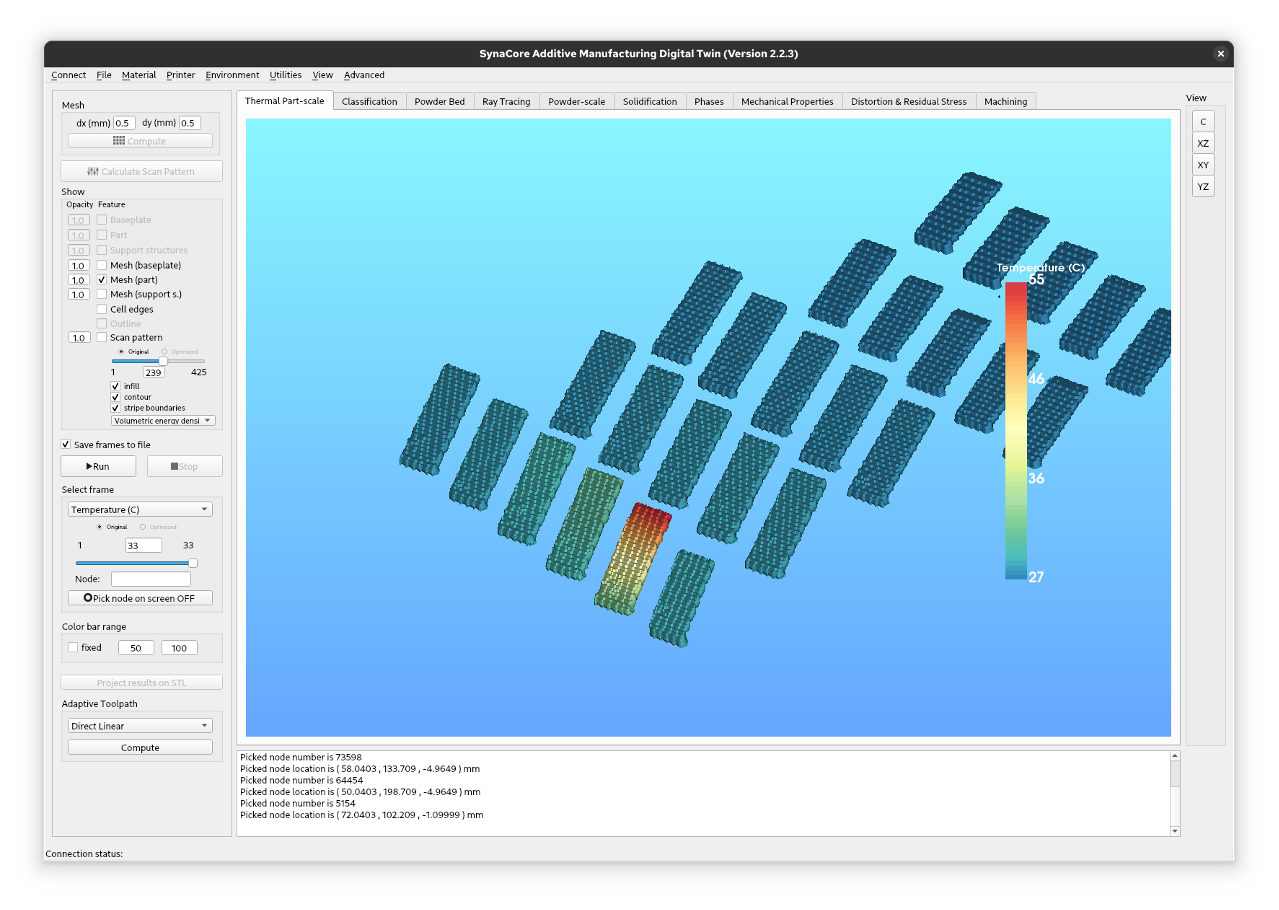
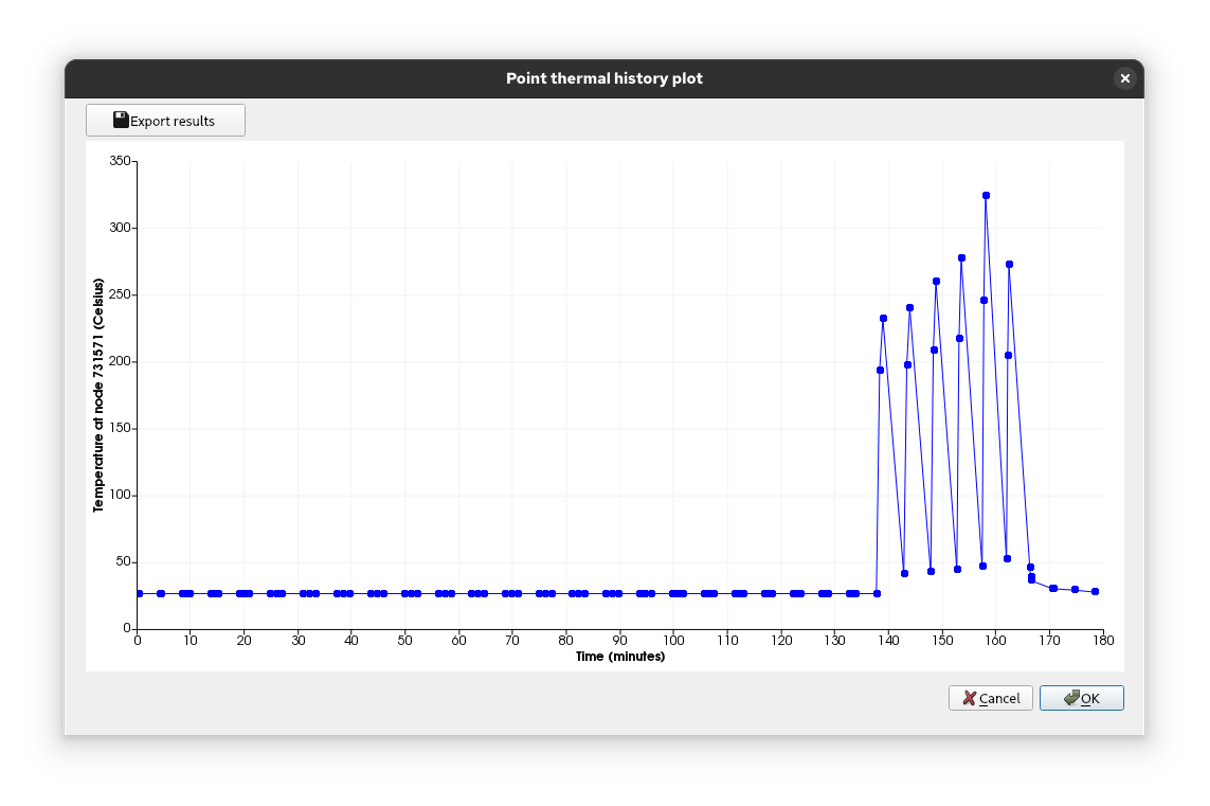
On the visualization front, SynaCore AM-DT MAX 2.3.4 adopts CAD-grade parallel projection rendering to eliminate perspective distortion, supporting continuous zoom and measurement of scan vectors. Whether tracking inter-layer temperature evolution in overhang structures or thermal field coupling in multi-part builds, users obtain engineering-grade visual feedback that provides trustworthy digital evidence for future part Pre-Qualification (see: Self-Evolution).
It is worth emphasizing that the Adaptive Toolpath in SynaCore AM-DT 2.3.4 is currently the world's only simulation-informed adaptive scan path system—its path optimization is driven directly by multi-scale simulation results rather than relying solely on geometric rules or empirical templates. SynaCore AM-DT MAX 2.3.4 fundamentally transforms simulation insights into process instructions. Users may subscribe to the SynaCore AM-DT Pro + Adaptive ToolPath edition to access the adaptive toolpath module.
II. AI Alloy Expands to Three Major Alloy Families: Ushering in the Algorithm-Driven Era of Materials Development
Internationally, advanced materials development has long faced a structural bottleneck. In its Vision 2040: Integrated Multi-Scale Modeling and Simulation Roadmap for Materials and Systems, NASA notes that the cycle from screening and design to final airworthiness certification is too long to meet the rapid iteration demands of future aviation systems. At a deeper level, materials scientists and structural engineers have long operated in silos—the former focusing on process and microstructure, the latter relying on static test data for component design—creating a broken information flow. NASA's report also reveals a startling reality: approximately 40% of experimental data is discarded after a single use, never to be reused. This means the material knowledge and data that enterprises invest heavily to accumulate never convert into sustainably appreciating digital assets.
The AI Alloy integrated within SynaCore AM-DT MAX 2.3.4 currently covers three major alloy systems: nickel-based alloys (such as IN718 commonly used in aero-engines), iron-based alloys (steels, from classical stainless steel 316L, to advanced maraging steel), and titanium alloys, with aluminum alloys and additional material systems in pipeline for the next release . This roadmapaligns closely with the competitiveness shift advocated by NASA Vision 2040. The AI Alloy integrated in SynaCore AM-DT transforms material properties from isolated static test curves into dynamic outputs. Leveraging SynaCore's multi-modal, multi-scale simulation capabilities, AI Alloy enables the user to explore composition-process-performance mapping relationships within the AM-DT digital twin's cross-scale framework, replacing the traditional experience-and-trial-error model. Users may subscribe to the SynaCore AM-DT Pro + AI Alloy edition to access the intelligent alloy module.
III. Powder-Scale Microstructure Prediction: More Intuitive
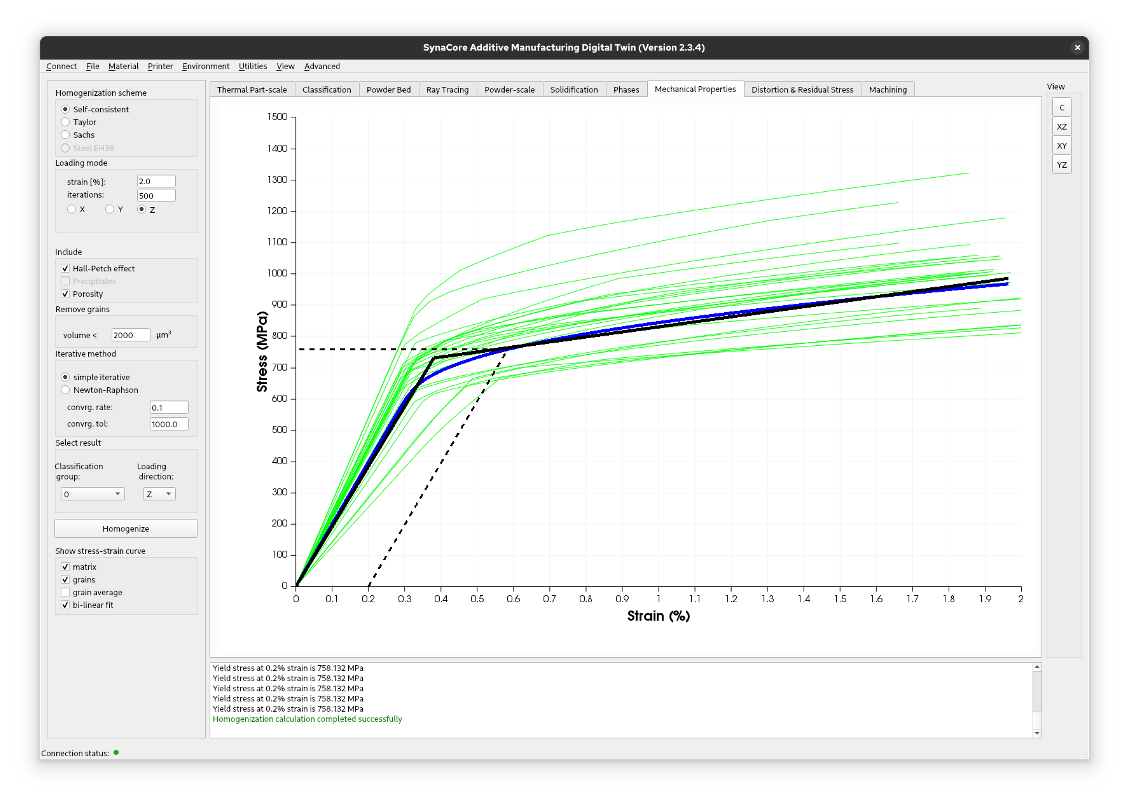
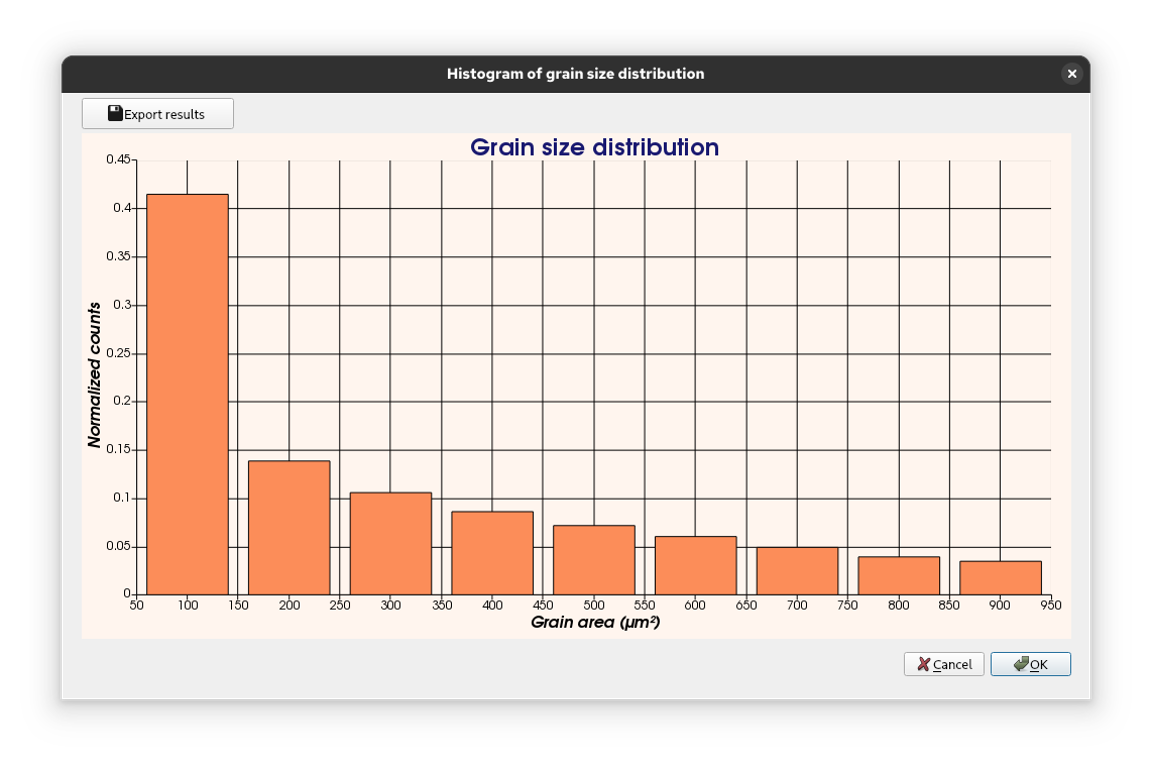
SynaCore AM-DT 2.3.4 also strengthens powder-scale microstructure prediction capabilities. Through full-cube material microstructure simulation, users can directlyobtain grain size distribution histograms and mechanical property predictions. The grain size histogram is computed from the digital 3D microstructure using the exact same procedure used when analyzing real EBSD maps, thus providing trustable source of quantitative data. Equally importantly, the microstructure calculation is informed by the inter-layer temperature , enabling the user to capture critical features such as grain size dependence on local temperature.
IV. End-to-End Native Coupling: Eliminating the Pain Point of Multiple Simulation Packages
Traditional AM simulation has long faced a structural dilemma. Macro-scale finite element methods must simplify heat source models to achieve speed, at the cost of losing melt pool dynamics detail; micro-scale simulations can capture grain nucleation and growth, yet cannot bear the computational load of full-part geometries. The market typically requires purchasing multiple simulation software packages to simulate the same part, tearing thermal analysis, microstructure simulation, mechanical property mapping, and deformation/residual stress calculations across different platforms.
This can extend the simulation cycle for a complex part to several weeks or even months. Moreover, because computational results belong to different software packages, root-cause tracing becomes nearly impossible. When a finished part exhibits cracking, was it because the thermal analysis miscalculated temperature? Or because the microstructure mapping distorted grain models? Or because boundary conditions were not properly transferred during stress calculation? As data changes hands across different simulation tools, fundamental traceability is lost.
The traditional simulation workflow typically presents the following fragmented landscape:
Macro thermal analysis: Using finite elements to compute part-level thermal history;
Meso/microstructure simulation: Employing dedicated phase-field coupled with lattice boltzmann method to predict melt pool size and solidification microstructures;
Mechanical property mapping: Using crystal plasticity and self-consistent homogenization to infer stress-strain response;
Deformation and residual stress: Returning again to macro finite element platforms, importing thermal cycle results as boundary conditions to calculate warping and support failure risks.
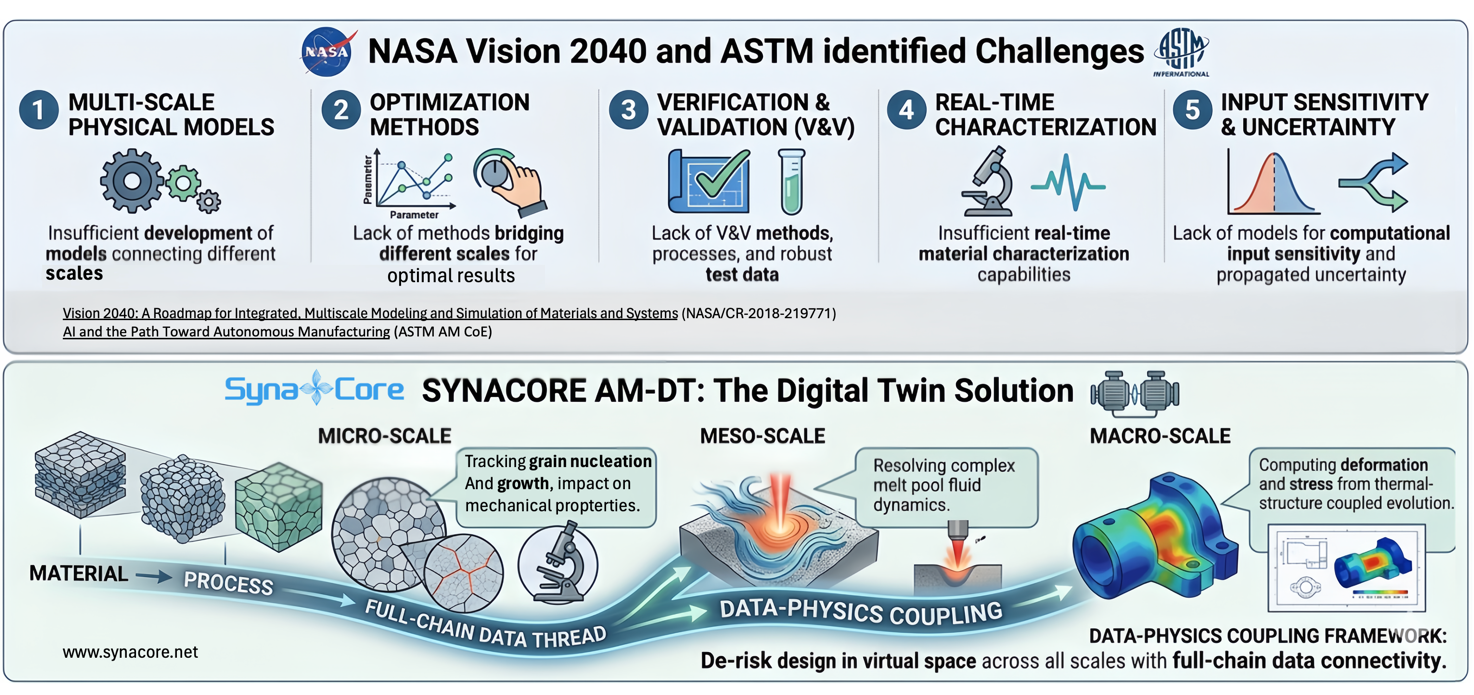
This dilemma is not an isolated case. NASA's Vision 2040 report explicitly identifies five critical technology gaps in multi-scale modeling: insufficient development of physical models connecting different scales; lack of optimization methods bridging different scales; lack of verification and validation methods and data; insufficient real-time characterization capabilities; and lack of models for computational input sensitivity and propagated uncertainty. Furthermore, ASTM expert discussions internationally highlight that data interoperability in additive manufacturing is particularly acute—different organizations and equipment platforms store and express the same data in heterogeneous ways, making it difficult for AI systems to understand and compare across platforms. These universal international challenges have kept many manufacturing AI projects stuck at the pilot validation stage; the limiting factor is often not the algorithm, but the underlying data infrastructure and multi-scale interoperability.
SynaCore AM-DT effectively addresses these challenges by providing the underlying data infrastructure and multi-scale interoperability. SynaCore AM-DT constructs a multi-scale, multi-fidelity data-physics coupling framework. Through full-chain data connectivity spanning "material-process-performance," SynaCore enables design teams to de-risk in virtual space—at the micro-scale, tracking grain nucleation and growth and their impact on mechanical properties; at the meso-scale, resolving melt pool fluid dynamics; and at the macro-scale, computing deformation and stress from thermal-structure coupled evolution.
Moreover, within the SynaCore AM-DT digital twin, its grain growth model, solidification analysis module, and melt pool fluid dynamics solver run in parallel. SynaCore AM-DT digital twin purpose-built parallel solvers scale well even with more than 40 cores.
Finally, it is worth emphasizing that the capabilities described in SynaCore AM-DT digital twin are not an overnight creation, but the culmination of years of deep, sustained groundwork at A*STAR IHPC (Institute of High Performance Computing, Singapore). In addition, SynaCore sincerely thanks industry partners from the 3C, semiconductor, energy, and additive manufacturing equipment sectors for their invaluable input during the early development of AM-DT 2.3.4. It is this feedback from leading manufacturing enterprises that has driven AM-DT to evolve alongside its users, jointly powering the intelligent leap in additive manufacturing. SynaCore believes that strong reputation comes from genuine collaboration, advancing the industry together. Visit www.synacore.net to request a software trial.
About SynaCore
Originating from the Institute of High Performance Computing (IHPC) at Singapore's Agency for Science, Technology and Research (A*STAR), SynaCore is a technology company registered in Singapore. Its mission is to enable scalability and sustainability through intelligent digital twin transformation, with a vision to drive physical manufacturing with virtual intelligence.
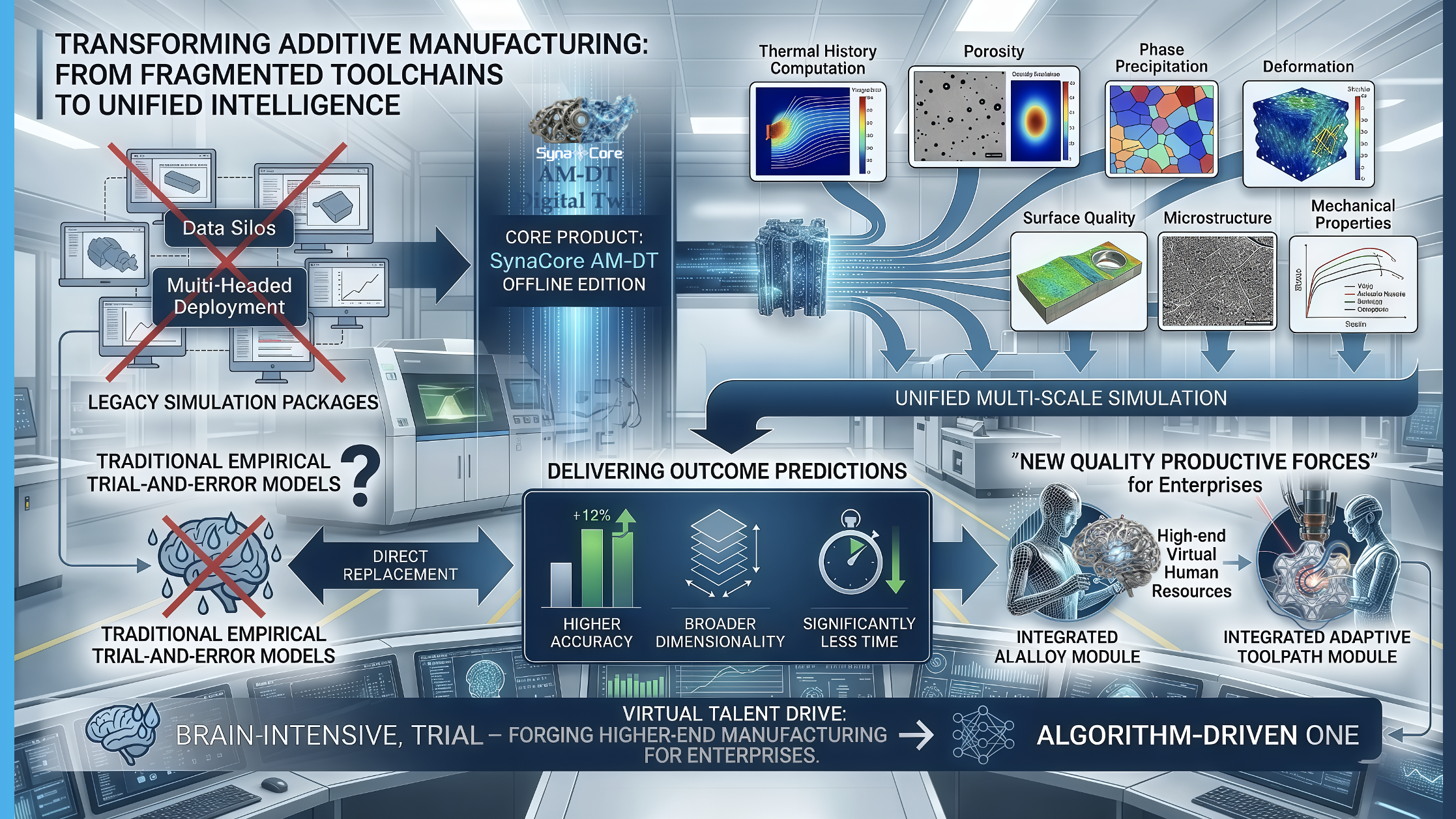
The core product, the SynaCore AM-DT offline edition, replaces traditional clusters of multiple simulation software packages with unified multi-scale simulation—encompassing thermal history computation, porosity, phase precipitation, deformation, surface quality, microstructure, mechanical properties, heat treatment prediction, and more—to deliver additive manufacturing outcome predictions of higher accuracy and broader dimensionality in significantly less time. This ends the predicament of fragmented simulation toolchains plagued by multi-headed deployment and data silos. Going further, the platform’s integrated AI Alloy and Adaptive ToolPath modules serve as "new quality productive forces" in additive manufacturing, Those modules serve as high-end virtual human resources for enterprises advancing into advanced manufacturing,embedding alloy design and metal 3D printing process optimization as scalable, on-demand intelligent engines that directly replace traditional empirical trial-and-error models. This transforms alloy development and process optimization from a brain-intensive, trial-and-error-heavy paradigm into an algorithm-driven one.