How Digital Twinning and Evolution Turn Shop-Floor Experience into Manufacturer-Owned Assets, Breaking the Cycle of Homogenized Competition
In metal additive manufacturing, taking a part from design to qualification typically requires eight to ten physical builds. Each iteration burns material, machine time, and labor; layered on top are the calendar costs of inspection and certification. For the enterprise, this is not merely an R&D expense—it is a recurring operational drain that cannot be depreciated into a balance-sheet asset. Worse, the failed metal 3D prints generated along the way are rarely converted into systematic, reusable institutional knowledge.
Traditional industrial software is designed to help manufacturers “do things right”—optimizing workflows, improving efficiency, and reducing resource waste per unit time. What the enterprise receives is a standardized capability. The usage process produces no exclusive knowledge accumulation. When the license expires or the technology generation shifts, the operational experience locked in the previous software seldom translates into a competitive moat.
SynaCore’s AM-DT digital-twin platform operates on a fundamentally different logic: the act of using it is simultaneously an act of asset creation. The system is built on two interlocked dimensions: Twinning and Evolution.
Twinning refers to multi-modal, multi-scale predictive simulation. “Multi-modal” denotes multi-source data inputs—thermal imaging, acoustic emission, optical monitoring, and multi-physics coupling spanning thermal, mechanical, and fluid dynamics. “Multi-scale” describes the spatial and temporal span of the simulation, bridging powder-bed meso-scale behavior, melt-pool micro-scale physics, and finished-part macro-scale performance. This end-to-end predictive capability cuts manufacturing costs and accelerates innovation. Cost avoidance and speed gain constitute the first asset attribute of AM-DT.
Evolution is the second dimension. The digital twin in the SynaCore framework is dynamic, learning, and adaptive. Through continuous feedback from sensors, the model self-calibrates, progressively converging on the ground-truth physics of the actual production environment. In doing so, it generates new digital intelligence—unique, ever-evolving, and imprinted with the manufacturer’s own operational DNA. This proprietary, self-updating wisdom is the second asset attribute.
An Asset That Appreciates
The core product, the SynaCore AM-DT offline edition, replaces traditional clusters of multiple simulation software packages with unified multi-scale simulation—encompassing thermal history computation, porosity, phase precipitation, deformation, surface quality, microstructure, mechanical properties, heat treatment prediction, and more—to deliver additive manufacturing outcome predictions of higher accuracy and broader dimensionality in significantly less time. This ends the predicament of fragmented simulation toolchains plagued by multi-headed deployment and data silos. Going further, the platform’s integrated AI Alloy and Adaptive ToolPath modules serve as "new quality productive forces" in additive manufacturing, Those modules serve as high-end virtual human resources for enterprises advancing into advanced manufacturing,embedding alloy design and metal 3D printing process optimization as scalable, on-demand intelligent engines that directly replace traditional empirical trial-and-error models. This transforms alloy development and process optimization from a brain-intensive, trial-and-error-heavy paradigm into an algorithm-driven one.
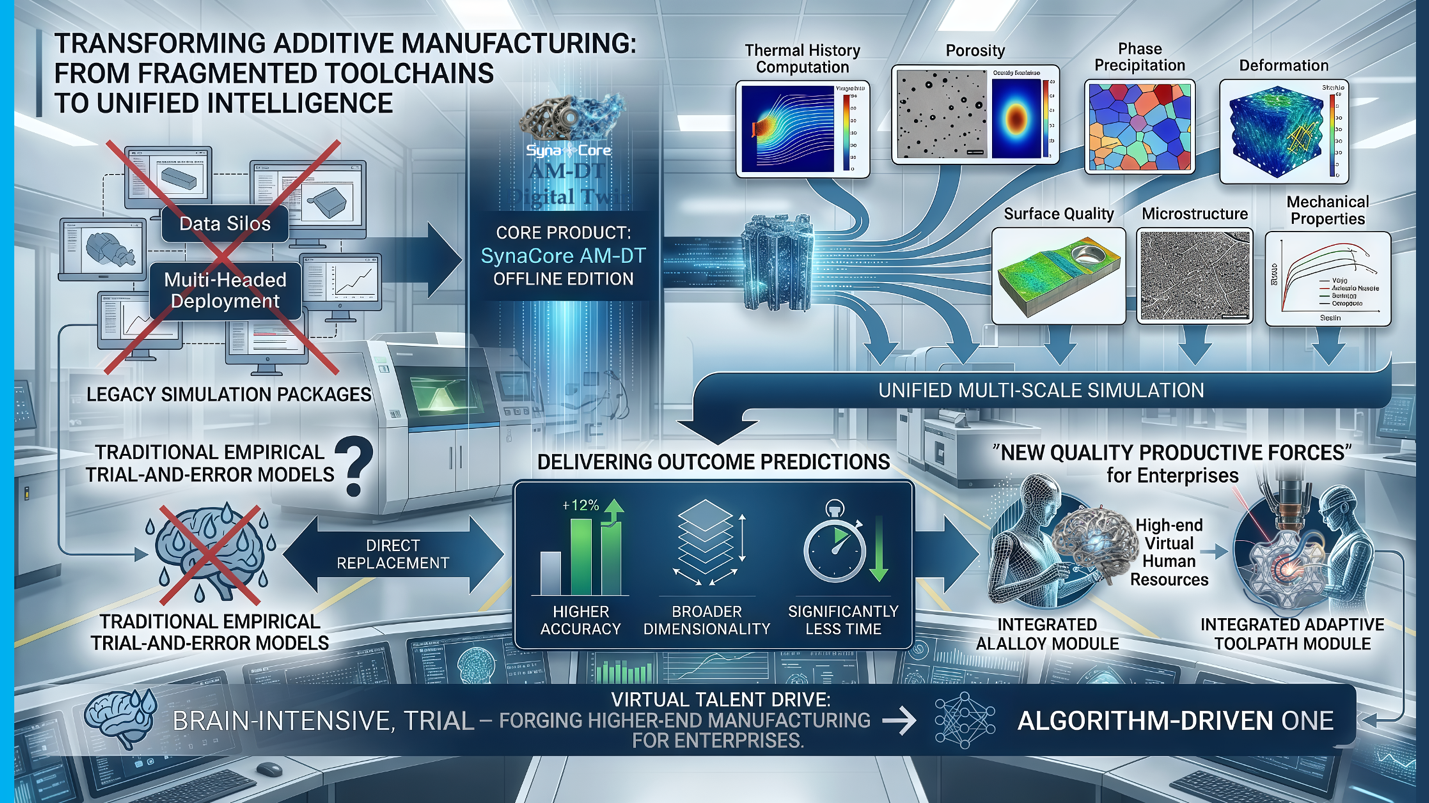
The SynaCore AM-DT engine ingests two classes of inputs. The first is universal physics—how metal powders melt and solidify under energy input, heat-transfer paths, and phase-transition rules. These first-principles form the software’s base code. The second is manufacturer-specific context: the exact machine model, part geometry, powder lot characteristics, and process parameters. Captured via thermal cameras, optical sensors, and acoustic monitors, then cross-referenced with post-process inspection data, these real-world signals continuously refine the predictive model. The result is an asset that appreciates in value the more it is used.
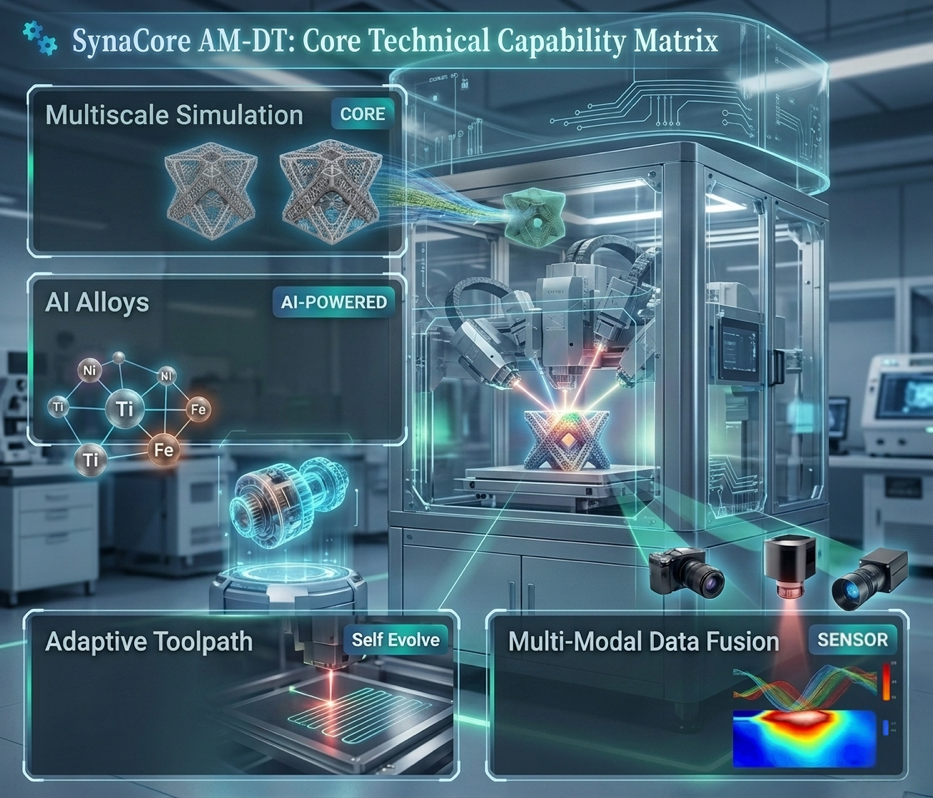
Consider the following example. As demand for AI computing power surges, higher performance generates more heat, prompting many manufacturers to adopt 3D-printed heat sinks with complex helical geometries to improve thermal management. Suppose a manufacturer seeks to rapidly develop and iterate such capabilities. They must simultaneously tackle design challenges (how to structure the geometry), material challenges (which alloy to use), and process challenges (which scanning strategy and laser parameters to adopt). The complexity of this development process resembles the old saying, "pressing down a gourd only to have a ladle pop up"—fix one problem and another immediately surfaces. If to adjust the design today, then need to tweak the scanning strategy and laser power, and print a part that shows improved thermal performance; then if switch the material tomorrow, and the corresponding design and process parameters must be reworked, followed by another physical build and another round of inspection...
With SynaCore’s AM-DT digital twin, these siloed challenges are unified on a single software platform that spans the entire workflow, enabling rapid iteration. The manufacturer only commits to a physical build when the virtual solution nears the optimal combination. The resulting iteration history is a rich dataset of design, material, and process parameters. This dataset is not merely predictive; it is grounded in both successful and failed prints. Because these processes carry the manufacturer’s unique DNA, they constitute proprietary wisdom—exclusive, non-replicable, and continuously appreciating core digital assets. The platform breaks down data silos, transforming individual intuition into an organizational asset that can be accessed and deployed at will.
Moreover, the AI Alloy module, integrated into the SynaCore AM-DT additive manufacturing digital twin platform, is rewriting the development rules for alloys—including nickel-based superalloys, iron-based alloys, titanium alloys, aluminum alloys, and future high-entropy alloys—through its physics-driven + AI-evolution dual-engine approach. SynaCore AI Alloy does not merely accelerate experimentation; it reconstructs the knowledge foundation of alloy design through physics-embedded neural networks coupled with first-principles parameters. By precisely identifying golden formulations that are both manufacturable and high-performance from infinite compositional combinations, it transforms alloy development from slow, data-scarce trial-and-error into high-fidelity, digital-twin-driven high-throughput generative design.
Furthermore, the Adaptive ToolPath function, integrated into the SynaCore AM-DT additive manufacturing digital twin platform, is an intelligent process optimization system that transforms 3D printing from static parameter settings into a continuously self-improving manufacturing paradigm. Conventional 3D printing relies on fixed recipes—pre-set laser power, scanning speed, and hatch spacing—which ignore the ever-changing thermal field during the printing process. The Adaptive ToolPath integrated into SynaCore AM-DT generates production-ready optimized scan paths based on transient thermal finite element analysis. By fully predicting thermal responses in digital space before actual printing, SynaCore enables its customers to print high-quality parts with stable thermal signatures.
Assetization Builds Proprietary DNA
When a digital twin is treated as an asset rather than a tool, a company’s growth model undergoes self-evolution.
First, trial-and-error costs are converted into assets. Under the traditional model, every design change triggers a physical build, and R&D budgets are consumed in the "verification" phase. Yet the data generated during these trials is valuable for the digital twin’s learning. As the model’s calibration capability improves through continuous learning, the digital twin shifts much of the verification burden into virtual space.
Enterprises can evaluate internal defect distributions and mechanical properties before printing, reserving limited physical builds for the handful of designs that approach the optimal solution. This is not simply "saving money"; it is a shift of funds from consumptive expenditure to asset-building investment—the same budget that previously bought scrap metal and inspection hours is now transformed into data accumulation and model precision.
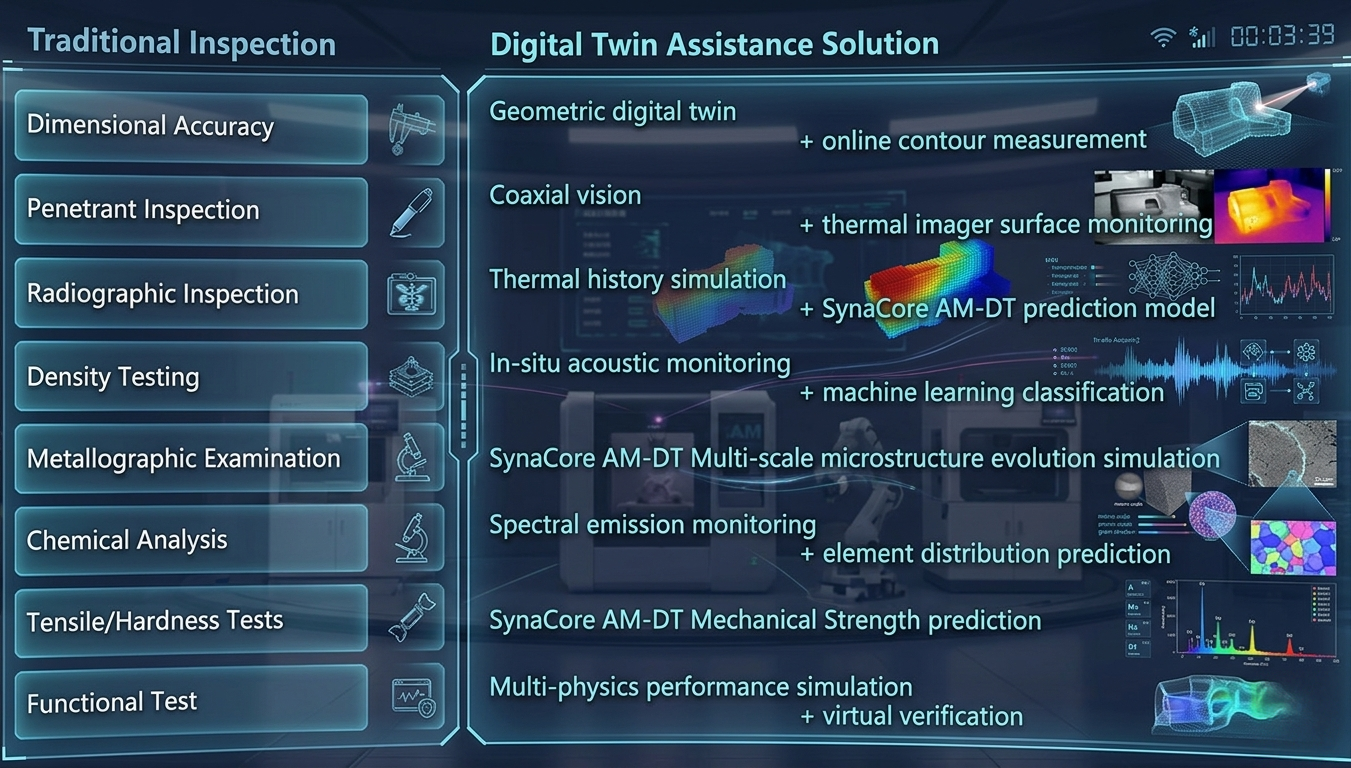
Second, there is a potential shift in the certification pathway. Take medical orthopedic implants as an example. The traditional certification of such porous structural components has long relied on destructive sampling and testing, requiring mechanical tests and biocompatibility validation on hundreds of samples, with cycles often stretching from 18 to 24 months. This not only suppresses the innovation space created by the inherent flexibility of additive manufacturing at the front end, but also—owing to the fundamental differences between additive and conventional manufacturing—drives certification and inspection costs extremely high.
In the near future, SynaCore’s AM-DT digital twin offers a different paradigm through the Digital Twin-enhanced Digital Product Passport (DT-DPP), which fuses data logging with predictive simulation. This is instrumental in accelerating and simplifying certification, because the DT-DPP embeds performance predictions for each part, enhancing the confidence level of product inspection and reducing the need for destructive testing.
Differentiation Breaks the Involution Trap
As these changes continue to unfold, they will gradually reshape the dimensions of industry competition.
What is the root cause of involution? Excess capacity, or homogenization? Observing the consumer market, the runaway success of Labubu lies essentially in product differentiation, not in limited-edition scarcity tactics. By the same token, involution in manufacturing stems largely from homogenization. When competition at the industrial level is reduced to sameness, involution is inevitable, and the grind only intensifies.
SynaCore’s AM-DT digital twin lowers the cost of innovation, punching through the high ceiling of capital and time investment that constrains innovative capacity. Competition therefore shifts from who can offer the lowest price to who can quickly and reliably solve problems that others cannot. On the first principles of this new competitive landscape, healthier industrial transformation is fostered. This wisdom-cultivation system reduces trial-and-error costs, shortens innovation cycles, assetizes the innovation exploration process, and effectively unlocks innovative potential. It gives enterprises the ability to compete through differentiation, the capital to upgrade their talent structures, and a path that avoids the involution trap.
This differentiation resembles species evolution in a rainforest: there is no single control center. Different enterprises continuously optimize around their own manufacturing data, forming irreplaceable specialized nodes. Equipment suppliers, material providers, and part manufacturers grow interdependent through data exchange, and the ecosystem structure shifts from a hub-and-spoke model to a networked, collaborative mesh. The whole becomes greater and more sustainable than the sum of its parts. With the vision of digital intelligence driving real manufacturing, SynaCore makes manufacturing more sustainable, helps every participant with genuine innovative strength grow its own unique competitive advantage, and enables shared prosperity.